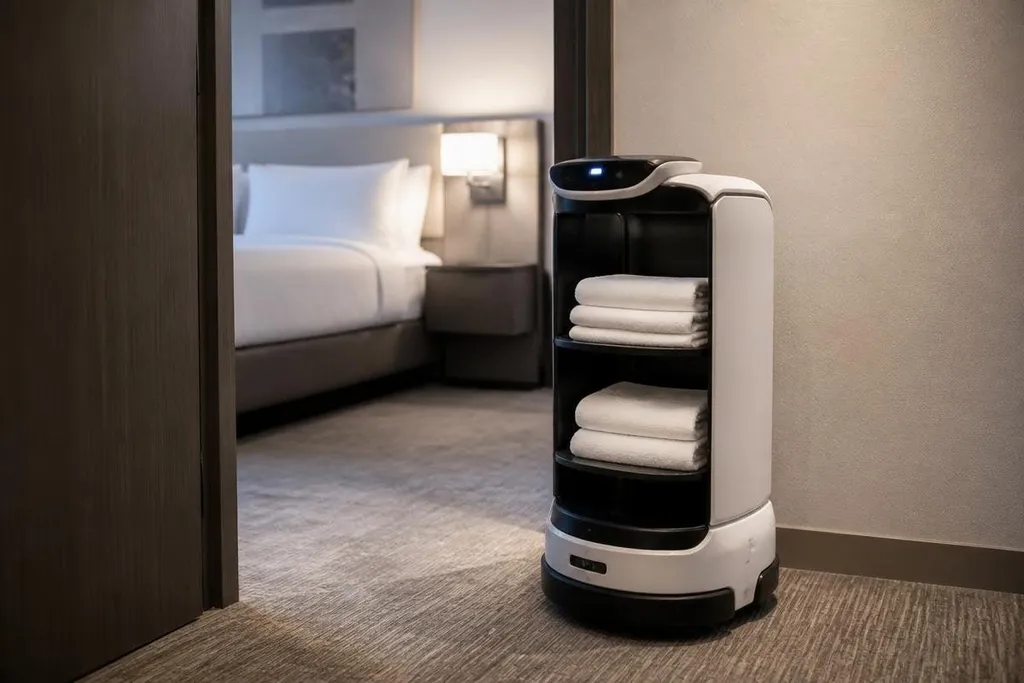
A hotel robot that carries towels or delivers room service takes on a small job with clear limits. That makes it easier for owners to test than a system expected to run an entire hotel.
- Repeated trips can move to an autonomous system
- Staff still handle guests, exceptions, and safety checks
- The business case depends on layout, service volume, and upkeep
The jobs robots can handle
Hospitality robots usually work on narrow tasks. A delivery robot may carry food, drinks, towels, or cleaning supplies from one point to another. A floor robot can vacuum or scrub set areas, while a kiosk can handle parts of check-in or payment.
That narrow job matters because the robot only needs to do one thing well. It can follow mapped routes, stop when its sensors detect a person, and return to a charging point when its battery runs low. Staff can then spend more time on requests that need judgment or a human reply.
The work is repetitive, but the setting is not. A hotel has guests, luggage, doors, lifts, carts, and changing room layouts. A robot that works in a quiet corridor may need more checks in a busy lobby.
Why hotels and restaurants are testing them
The first reason is labor pressure. Hospitality work includes many short trips that take time but need little training, such as moving linen between floors or taking a meal to a room. A robot can cover some of those routes while employees stay at the desk, in the kitchen, or with guests.
The second reason is service demand outside normal staff patterns. A delivery robot can carry an order late at night when fewer employees are working. That does not remove the need for a person.
Someone still prepares the order, loads the robot, and deals with a blocked route or a guest who cannot open the delivery compartment.
Cost also shapes the decision. Owners have to compare the robot with wages, maintenance, charging, software, training, and the time needed to supervise it. A low purchase price can still lead to a poor result if the robot needs frequent help.
For a hotel owner, hospitality robotics coverage can show which service tasks have been tested in hotels and restaurants, rather than leaving the decision to a sales demo. The next issue is what guests notice during the exchange.
The guest experience decides the result
A robot earns its place when it removes a delay without adding a new one. Guests may accept a machine carrying towels through a corridor, but they still need a clear way to contact staff when the robot stops or the delivery is wrong.
Noise, size, and appearance matter too. A large unit may block a narrow lift. A loud drive motor can disturb guests at night. A robot that speaks too often can make a simple delivery feel slow.
Privacy needs a clear answer. Robots may use cameras, LiDAR, or other sensors to avoid people and objects. The hotel should explain what the system records, where that data goes, and how long it stays there.
Where the limits show up
Robots work best in buildings with stable routes and repeatable tasks. Stairs, heavy doors, crowded corridors, and frequent furniture changes can reduce the time a robot spends working without help.
Weather and building design can add more problems. An outdoor delivery robot may face rain, uneven paving, or a road crossing. An indoor unit may depend on lift access that the hotel has not connected to its control system.
The unproven part is the long-term cost. A short demonstration can show that a robot reaches a room. It does not show how often staff must reset it, how quickly parts wear out, or how guests respond after months of use.
A practical buying check
Before a hotel or restaurant orders a robot, check these points:
- Name the route: measure doors, lifts, ramps, floor changes, and busy areas.
- Count the task: record how many trips happen in a shift and how long each takes.
- Plan the handoff: assign a person to load, unload, and fix stopped deliveries.
- Check the data: ask what sensors record and who can access those records.
- Price the service: include software, batteries, repairs, training, and staff time.
A pilot should track completed trips, staff interventions, delivery time, guest complaints, and repair calls. Those records give the owner something better than a polished demonstration.
I’d choose a robot for a repeated route only after a measured pilot shows that staff intervention stays low. Hospitality robots are becoming more common because their jobs are easier to define, but the next test is simple: can they keep working through a busy shift without making people manage the machine?